Existential Crisis of an English Teapot - 2025, India, Munnar (Dutch and French languages down below)
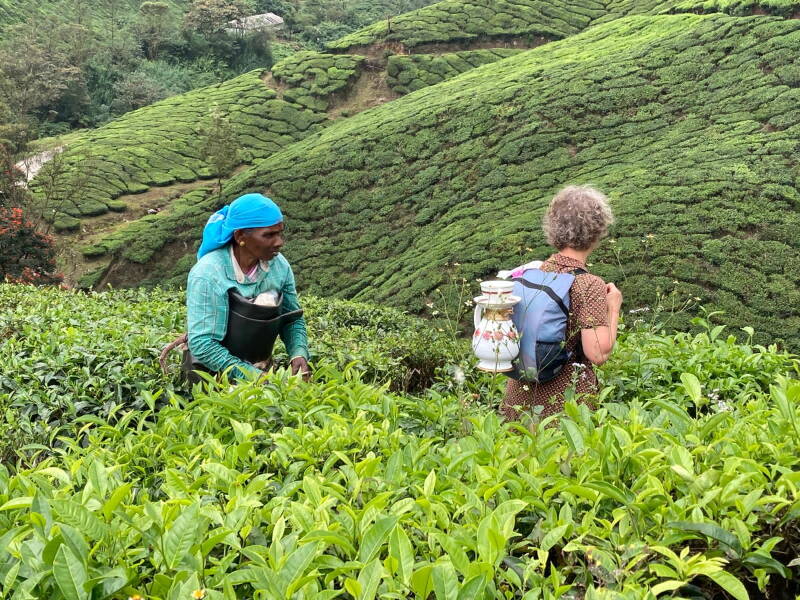
Due to a kind of existential crisis, an English teapot decides to start looking for her roots. She thus leaves for the tea plantations of Munnar in the south of India. She is struck by the breathtakingly beautiful landscape of some 13.000 hectares of plantations.
Despite the strong historical ties with the English market, Munnar teas are being traded throughout the entire world. The exact number of tea pickers is unknown, but they form the backbone of the regional tea production. Their working conditions are characterized by low salaries, long days and a lack of basic facilities on the plantations. This poses a complex problem with deep roots in the colonial past and the current economic reality of the tea industry.
(Materials: backpack, plane ticket, teapot, cup and saucer)



Existentiële crisis van een Engelse theepot - 2025, Munnar, India
Vanwege een existentiële crisis besloot een Engelse theepot op zoek te gaan naar haar oorsprong. Zodoende vertrok ze naar de theeplantages van Munnar in het zuiden van India. Ze werd getroffen door het adembenemende landschap van 13.000 hectare aan plantages.
Ondanks de sterke historische band met de Britse markt wordt de thee van Munnar wereldwijd verhandeld. Het precieze aantal theepluksters is onbekend, maar zij vormen de ruggengraat van de regionale theeproductie. Hun werkomstandigheden worden meestal gekenmerkt door lage lonen, lange werkdagen en een gebrek aan basisvoorzieningen op de plantages. Dit vormt een complex probleem met diepe wortels in het koloniale verleden en de huidige economische realiteit van de thee-industrie.
(Materiaal: rugtas, theepot, kop en schotel)
Crise existentielle d’une théière anglaise - 2025, Munnar, Inde
En proie à une crise existentielle, une théière anglaise décide de partir à la recherche de ses origines. Elle se rend dans les plantations de thé de Munnar, au sud de l`Inde. Elle est frappée par la beauté époustouflante des treize milles hectares de plantations.
Malgré ses liens historiques étroits avec le marché britannique, le thé de Munnar est commercialisé dans le monde entier. Le nombre exact de cueilleurs de thé est inconnu, mais ils constituent l`épine dorsale de la production régionale. Leurs conditions de travail sont généralement caractérisées par de bas salaires, de longues heures et un manque de commodités de base dans les plantations. Ceci pose un problème complexe, profondément enraciné dans le passé colonial et les réalités économiques actuelles de l`industrie du thé.
(Matières : sac à dos, théière, tasse et soucoupe)
Maak jouw eigen website met JouwWeb