History lesson in Tallinn - 2026, Tallinn, Estland (Dutch and French languages down below)
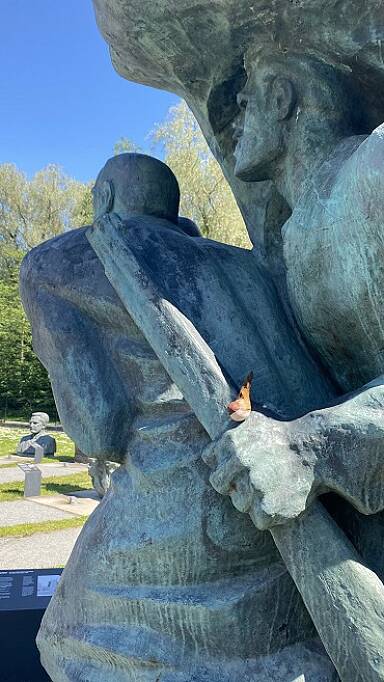
Free birds come and go, just like during the barriers of the Iron Curtain. For a talk. For a song. For a history lesson.
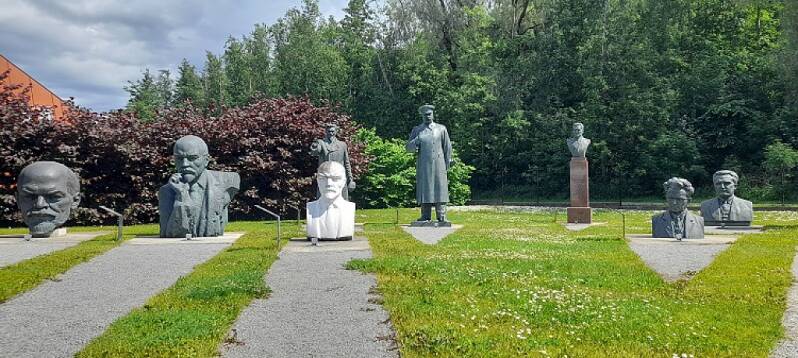
The story of the Iron Curtain passes through the whole of Europe, and thus is also to be found in the park of the Estonian History Museum in Tallinn (Estland). The statues from those days have gotten a special place there, although some still look majestic, others seem to have fallen off their pedestal.
The recovery of the independence of Estland from the Sovjet Union grew out of the Singing Revolution (1987 till 1991). The movement was completely nonviolent and used songs and mass demonstrations to help overthrow the Sovjet dominance.
The Singing Revolution showed how songs and culture in general can be used as a powerful means in the battle for political change and freedom.
The Baltic Way (1989) was a crucial highlight: a human chain of two million people was formed, from Tallinn via Riga to Vilnius. People held hands and sang and demonstrated for independence.
(Materials: decorative birds, double-sided tape)



Geschiedenis les in Tallinn – 2026, Tallinn, Estland
Vrije vogels komen en gaan, net als tijdens de barrières van het IJzeren Gordijn. Voor een gesprek. Voor een lied. Voor een geschiedenisles.
De historie van het IJzeren Gordijn loopt door heel Europa, en dus ook in het park van het Estonian History Museum in Tallinn (Estland). De beelden uit die tijd hebben daar een bijzondere plek gekregen. Sommige ogen nog steeds statig, andere lijken van hun voetstuk te zijn gevallen.
Het herstel van de onafhankelijkheid van Estland van de Sovjet-Unie ontstond als gevolg van de Zingende Revolutie (1987 tot 1991). De beweging was volledig geweldloos en men gebruikte liederen en massademonstraties om bij te dragen aan de onderdrukkende Sovjetoverheersing omver te werpen.
De Zingende Revolutie toonde aan hoe zang en cultuur kunnen worden ingezet als krachtig middel in de strijd voor politieke verandering en vrijheid. De Baltische Weg (1989) was een cruciaal hoogtepunt: een menselijke keten van twee miljoen mensen vormde zich van Tallinn via Riga tot Vilnius, waarbij mensen hand in hand zongen en demonstreerden voor onafhankelijkheid.
(Materiaal: decoratievogels, dubbelzijdig plakband)
Leçon d’histoire à Tallinn – 2026, Tallinn, Estonie
Les oiseaux vont et viennent, tout comme à l’époque du Rideau de fer. Pour une conversation. Pour une chanson. Pour une leçon d’histoire.
L`histoire du Rideau de fer s`étend à toute l`Europe, et donc également au parc du Musée d`histoire de l`Estonie à Tallinn. Les statues de l’époque soviétique y occupent une place particulière. Certaines ont conservé leur air majestueux, d`autres semblent être tombées de leur socle.
Le rétablissement de l’indépendance de l’Estonie vis-à-vis de l’Union soviétique est le fruit de la Révolution chantante (1987 à 1991). Ce mouvement, entièrement non violent, a eu recours à des chants et à des manifestations de masse pour contribuer au renversement de la domination oppressive soviétique.
La Révolution chantante a démontré comment le chant et la culture pouvaient être utilisés comme des outils puissants dans la lutte pour le changement politique et la liberté. La Voie balte (1989) a constitué un moment fort décisif : une chaîne humaine de deux millions de personnes s’est formée de Tallinn à Vilnius en passant par Riga, les participants chantant main dans la main et manifestant pour l’indépendance.
(Matériaux : oiseaux décoratifs, ruban adhésif double face)
Maak jouw eigen website met JouwWeb